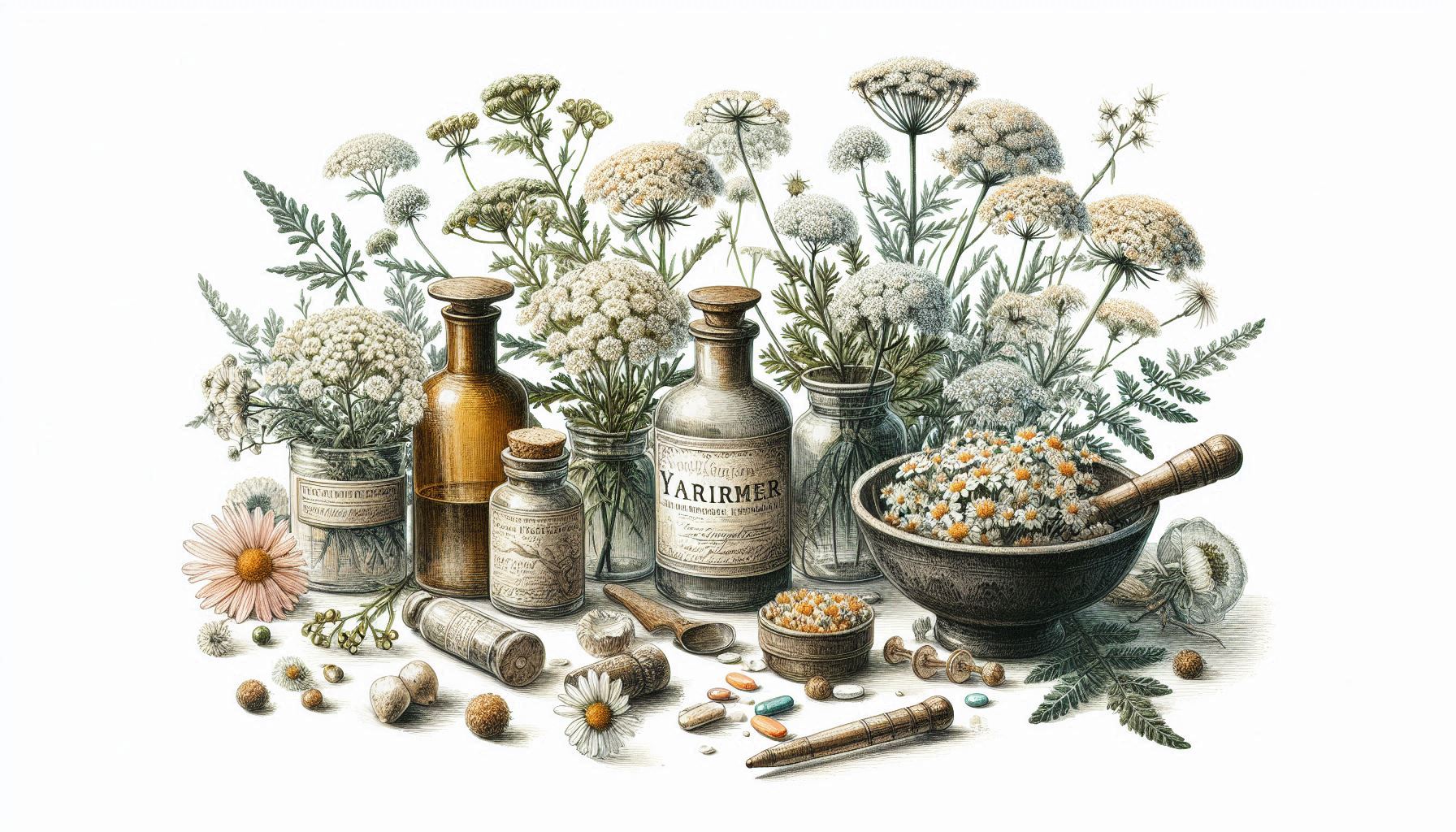
Our beautiful planet is home to over 500, 000 different plant species & of these more than 10,000 are used regularly throughout many cultures for healing purposes. It is my hope to share with you knowledge to empower you to help yourself or if that seems daunting, you always have the option of being able to contact me if you’d like some further guidance. Mother Nature has generously lavished us with gifts to help us in our times of need.
Let’s start with Yarrow…
Native to Europe, it has a long history as a wound healer, hence it was known as herba milataris, for its use staunching war wounds. Often taken internally as strengthening bitter tonic. Known to aid recovery from colds, flus & hay fever in addition to menstrual & circulatory disorders.
A creeping perennial, it grows to 1 metre (3 feet) with white flowers & finely divided leaves.

Yarrow, Milfoil
Achillea millefolium (Asteraceae)
| Habitat & Cultivation: |
|---|
| Native to Europe & Western Asia. |
| Can be found growing wild in temperate regions, in meadows & along verges. |
| This herbs spreads via its roots. |
| It’s aerial parts are best picked in summer when it’s in flower. |
| Key Constituents: |
|---|
| Volatile oil with variable content: Linalool: A naturally occurring terpene alcohol found in many flowers and spice plants, known for its pleasant floral aroma and various applications in perfumery and aromatherapy. Camphor: A white, waxy organic compound with a strong aroma, classified as a terpenoid and cyclic ketone, primarily derived from the wood of the camphor laurel (Cinnamomum camphora), and used in medicinal and industrial applications. Sabinene: Sabinene is a natural bicyclic monoterpene with the chemical formula C10H16, characterised by its spicy, citrusy, and pine-like aroma, and found in essential oils of various plants such as black pepper, nutmeg, and holm oak. Azulene: Azulene is a blue-coloured aromatic hydrocarbon compound consisting of fused five- and seven-membered rings, isomeric with naphthalene, and known for its unique structure and applications in cosmetics and organic synthesis. |
| Sesquiterpene lactones: Are a diverse group of plant-derived secondary metabolites characterized by a 15-carbon backbone and a lactone ring, known for their bitter taste and wide range of biological activities including anti-inflammatory, antimicrobial, and antitumor properties. |
| Flavonoids: A diverse class of plant-derived secondary metabolites characterized by a 15-carbon skeleton (C6-C3-C6) with two phenyl rings and a heterocyclic ring, known for their various biological activities and health benefits, including antioxidant, anti-inflammatory, and pigmentation properties. |
| Alkaloids: Achilleine: Alkaloids are a diverse class of naturally occurring organic compounds containing nitrogen atoms, typically derived from plants, that often have significant physiological effects on humans and animals. |
| Triterpenes: A class of naturally occurring compounds composed of six isoprene units, with the molecular formula C30H48, found in plants, animals, and fungi, and serving as precursors to many biologically important molecules like steroids. |
| Phytosterols: Are plant-derived compounds structurally similar to cholesterol that serve as components of plant cell membranes and are known for their ability to lower blood cholesterol levels in humans when consumed in sufficient quantities. |
| Tannins: Are polyphenolic compounds found in various plants that have astringent properties, contributing to the flavour and colour of foods and beverages, while also exhibiting antioxidant and antimicrobial activities. |
| Key Actions: |
|---|
| Antispasmodic: Relieves muscle spasms. |
| Astringent: Contracts & firms tissues & organs. Decreases secretions & discharges. Binds proteins, glycoproteins, & carbohydrates (mucin) in the body & on microorganisms. |
| Bitter tonic: An agent that increases tone & activity of gastric mucosa. Improves appetite. Stimulates gastric juices. |
| Increases sweating |
| Lowers blood pressure |
| Reduces fever |
| Mild diuretic & urinary antiseptic Increases the flow of urine. Prevents & counteracts inflammation & infection. |
| Stops internal bleeding |
| Promotes menstruation |
| Anti-inflammatory Reduces inflammation & swelling. Often used to alleviate pain & other symptoms. |
| Uses: |
|---|
| Healing wounds: Achilles reputedly used it to heal his wounds (this is how it got its botanical name. Has been used for this purpose for centuries. In Scotland it’s a traditional wound ointment. |
| Gynecological: It helps regulate the menstrual cycle. Reduces heavy menstrual bleeding. Eases period pain. |
| Other uses: Combined with other herbs it can help with colds & flu. Its bitter tonic properties make it useful for weak digestion & colic. Helps hay fever. Lowers high blood pressure. Improves venous circulation. Tones varicose veins. |
| Parts Used: |
|---|
| Aerial parts: Contains flavonoids, which are thought to give yarrow it antispasmodic properties. |


Leave a Reply