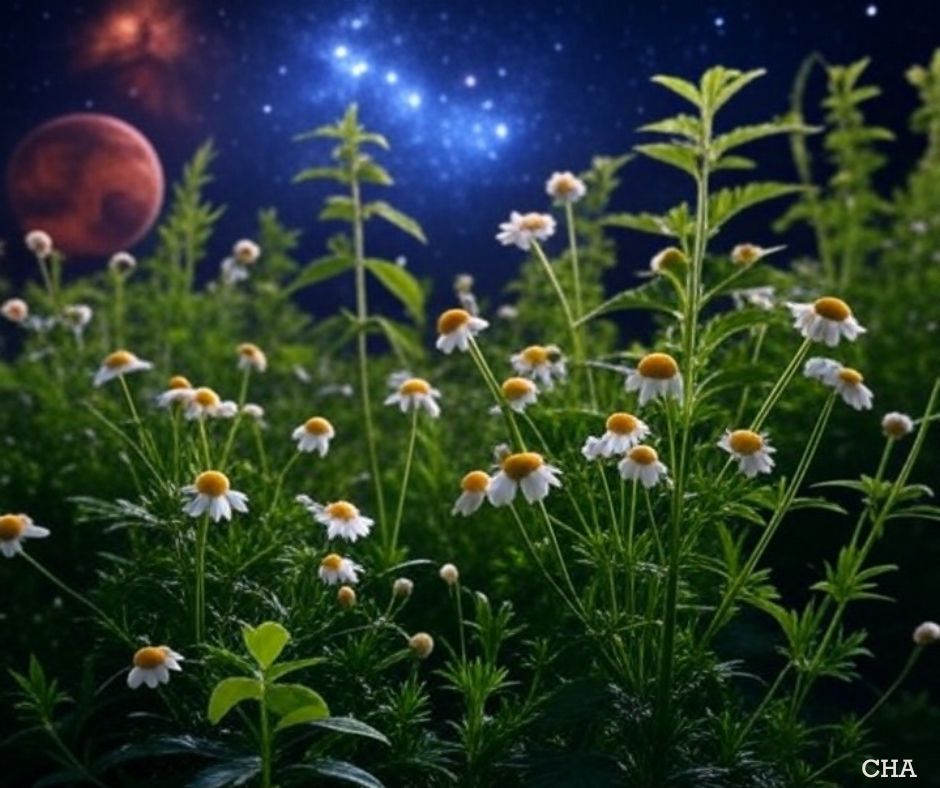
For centuries, the stars have guided humanity—not just in navigation or storytelling, but in the art of healing. Astrology and herbal medicine, two ancient practices, have long been intertwined, their roots tangled in the belief that the cosmos and the natural world are mirrors of one another. From the meticulous herbals of Nicholas Culpeper to the medicinal traditions of ancient Mesopotamia, the fusion of celestial wisdom and botanical knowledge has shaped how healers understand the body, illness, and the remedies drawn from the earth. This article delves into the historical, philosophical, and practical connections between astrology and herbal medicine, revealing a system of healing that is as poetic as it is profound.
A Cosmic Framework: The Foundations of Astrological Herbalism
At the heart of astrological herbalism lies the doctrine of correspondences, the idea that everything in the universe is interconnected. Ancient philosophers, from the Greeks to the alchemists of the Renaissance, believed that the macrocosm (the heavens) reflected the microcosm (the human body and the natural world). Planets, zodiac signs, and herbs were seen as part of a grand cosmic web, each influencing the others.
In this worldview, the seven classical planets—Sun, Moon, Mercury, Venus, Mars, Jupiter, and Saturn—were thought to govern specific physiological functions and organs. For example:
- The Sun ruled the heart and vitality, radiating warmth and life.
- The Moon governed fluids, the stomach, and the feminine cycles, waxing and waning like the tides.
- Mars controlled muscles and blood, its fiery energy linked to action and inflammation.
- Venus presided over the kidneys, skin, and reproductive system, embodying beauty and harmony.
Similarly, the twelve zodiac signs were mapped onto the body, creating a celestial anatomy. Aries ruled the head, Taurus the throat, Gemini the lungs, and so on, down to Pisces, which governed the feet. Herbs, too, were assigned planetary and zodiacal rulerships based on their properties, appearance, or effects. A plant with heart-shaped leaves might fall under Venus, while a fiery, red-berried herb could be ruled by Mars.
This system wasn’t arbitrary; it was a way to organize the natural world. By understanding a plant’s astrological signature, healers could match it to a patient’s ailment, aligning the remedy with the cosmic forces at play. The practice was both science and art, blending observation, intuition, and celestial timing.
Nicholas Culpeper: The Star-Struck Herbalist
No figure embodies the marriage of astrology and herbalism more vividly than Nicholas Culpeper, the 17th-century English astrologer-physician. His seminal work, Culpeper’s Complete Herbal (1653), is a treasure trove of botanical and astrological knowledge, still consulted by herbalists today. Culpeper believed that “the herbs of the field are the physicians of the poor,” and he democratized healing by writing in English, making his wisdom accessible to the masses.
Culpeper assigned each herb a planetary ruler, linking its medicinal properties to the cosmos. For example:
- Chamomile, ruled by the Sun, was used to treat fevers and promote vitality, its golden flowers echoing the Sun’s radiance.
- Nettle, governed by Mars, was prescribed for blood purification and to combat weakness, its stinging leaves reflecting Mars’ fiery, combative nature.
- Rosemary, under the Sun’s dominion, was recommended for memory and circulation, its invigorating scent aligning with solar energy.
Culpeper also emphasized the timing of herbal preparation. He advised harvesting herbs when their ruling planet was strong—say, picking Sun-ruled herbs at dawn during Leo’s season or Moon-ruled plants under a full moon. This ensured the plant’s potency was at its peak, infused with celestial energy. His approach wasn’t just practical; it was a spiritual act, honoring the harmony between earth and sky.
Historical Roots: From Mesopotamia to the Renaissance
The connection between astrology and herbalism stretches back to the dawn of civilization. In ancient Mesopotamia, priests used star charts to diagnose illnesses, believing that celestial events influenced health. The Babylonians associated plants like myrrh with the Sun and used them in rituals to invoke divine healing.
In ancient Greece, Hippocrates and Galen incorporated astrology into their medical practices, timing treatments based on planetary alignments. The Greek physician Dioscorides, in his De Materia Medica (1st century CE), described hundreds of plants and their uses, often with implicit astrological connections that later herbalists would expand upon.
During the Islamic Golden Age, scholars like Avicenna blended Greek, Persian, and Indian traditions, refining the use of astrology in medicine. By the European Renaissance, medical astrology was a cornerstone of healing. Universities taught physicians to cast horoscopes for patients, determining the best times for surgery or administering remedies. Herbals from this period, like John Gerard’s The Herball (1597), often included astrological notes, reflecting the era’s belief that plants were earthly reflections of the stars.
Practical Applications: How Astrology Guided Herbal Medicine
Astrological herbalism wasn’t just theoretical; it was deeply practical. Healers used astrology in three key ways:
- Diagnosis: By casting a patient’s natal chart or a “decumbiture” chart (a horoscope for the moment they fell ill), physicians could identify which planet or sign was afflicted. For instance, a headache might suggest an imbalance in Aries, prompting the use of Aries-ruled herbs like feverfew.
- Remedy Selection: Herbs were chosen based on their planetary or zodiacal rulerships to counterbalance the patient’s condition. If Saturn, associated with cold and dryness, was causing joint pain, a Jupiter-ruled herb like dandelion—warm and moist—might be prescribed to restore equilibrium.
- Timing: The lunar cycle and planetary hours were critical for harvesting, preparing, and administering herbs. A Venus-ruled herb like rose was most potent when harvested on a Friday (Venus’ day) during a waxing moon, amplifying its soothing, heart-healing properties.
This approach required intimate knowledge of both astrology and botany. Healers had to observe the stars, track planetary transits, and understand the humoral system (the balance of hot, cold, wet, and dry qualities in the body). The result was a holistic practice that treated the patient as a microcosm of the universe.
Modern Astrological Herbalism: A Renaissance of Ancient Wisdom
While the scientific revolution sidelined astrology in favor of empirical medicine, astrological herbalism never disappeared. Today, it’s experiencing a revival as people seek holistic, nature-based healing. Modern herbalists like Sajah Popham and Matthew Wood incorporate astrological principles, using planetary correspondences to deepen their understanding of plants. For example, Popham’s Evolutionary Herbalism explores how a plant’s astrological signature can guide its therapeutic use, from physical to emotional healing.
Astrology also informs biodynamic farming, a practice pioneered by Rudolf Steiner in the 1920s. Biodynamic farmers plant and harvest according to lunar and planetary cycles, believing that cosmic rhythms enhance crop vitality. Studies, like those published in the Journal of Agricultural Science (2019), suggest biodynamic methods can improve soil health and plant resilience, lending credence to these ancient practices.
In wellness circles, astrological herbalism is gaining traction. People brew Moon-ruled teas like peppermint during a full moon for emotional clarity or use Mars-ruled cayenne to boost energy during a sluggish transit.
The Science and the Spirit
Skeptics may question the validity of astrological herbalism, pointing to the lack of double-blind studies. Yet, the practice’s longevity speaks to its efficacy, at least within its cultural context. Many herbs assigned to specific planets have proven medicinal value—chamomile (Sun) is a known anti-inflammatory, and nettle (Mars) is rich in iron, supporting blood health. The placebo effect, too, can’t be discounted; belief in a remedy’s cosmic alignment may enhance its psychological impact.
Beyond science, astrological herbalism offers a spiritual framework for understanding our place in the universe. It invites us to see the body as a constellation, the garden as a galaxy, and healing as a dance between earth and sky. In an era of disconnection, this practice reconnects us to nature’s rhythms and our own inner cosmos.
Tending the Celestial Garden
The links between astrology and herbal medicine are a testament to humanity’s quest for harmony. From Culpeper’s starlit herbals to modern biodynamic farms, this tradition weaves together observation, intuition, and reverence for the cosmos. Whether you’re a skeptic or a believer, there’s something undeniably enchanting about choosing a remedy under a waxing moon or planting rosemary when the Sun is in Leo.
As we navigate an increasingly complex world, astrological herbalism reminds us that healing is not just a science but a story—one written in the language of stars and roots. So, the next time you sip a cup of chamomile tea or crush a sprig of lavender, consider the planets overhead. You might just feel the pulse of the universe in your hands.



Leave a Reply